As an Amazon Associate, we earn from qualifying purchases. Some links on this site are affiliate links at no extra cost to you. Our recommendations are based on thorough research and editorial judgment.


How to Use a Practice Pad for Maximum Skill Transfer

To use a practice pad for maximum skill transfer, drummers should focus on essential rudiments like single and double strokes, practicing with a metronome to enhance timing and control. Regularly engage in hand coordination exercises, such as paradiddles and flams, to develop muscle memory. Adjusting tempos during practice fosters adaptability. Keeping a practice journal allows tracking of improvements and setting specific goals can enhance focus. Embracing structured routines can refine overall technique, leading to better performance on an actual drum kit. More insights await!
Key Takeaways
- Focus daily practice on essential rudiments like single and double strokes to build muscle memory and technical control.
- Incorporate a metronome to enhance timing consistency and adaptability across various tempos during practice sessions.
- Keep a practice journal documenting time spent on exercises and noting improvements to track progress effectively.
- Set specific practice goals for each session and prioritize quality over quantity for thorough skill development.
- Experiment with hybrid routines that combine rudiments with varied tempos to reinforce techniques for live performances.
Understanding the Purpose of a Practice Pad

You may be interested


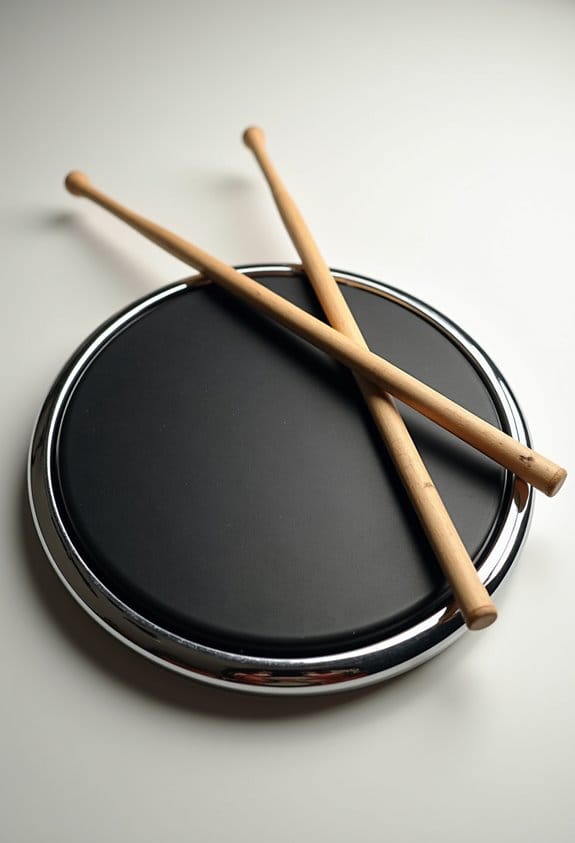
While it may seem like a simple tool, a practice pad plays an essential role in the development of a drummer’s skills. This versatile surface simulates a drum, enabling focused practice free from distractions. Regular use of a practice pad is important for honing key abilities, such as speed, control, and familiarization with various rudiments, including double strokes. By repeatedly practicing on this resilient surface, drummers build significant muscle memory, enhancing their overall performance on an actual kit. Additionally, employing a metronome while practicing can greatly improve timing and rhythmic accuracy. The practice pad not only supports steady progression but also ingrains essential patterns into a drummer’s skillset, ultimately paving the way for more complex rhythms and techniques. Choosing a practice pad made from high-density silicone can further improve the realism of stick rebound and make practice sessions more effective.
Key Rudiments to Focus On

Focusing on fundamental rudiments is essential for any drummer looking to develop a strong foundation in their craft. Key rudiments like single strokes (RLRL) and double strokes (RLRR) serve as the backbone of drumming, forming the basis upon which more advanced skills are built. Practicing paradiddles (RLRR LRLL) greatly improves hand coordination and speed, crucial for intricate drumming. Incorporating flams can enhance hand placement and movement efficiency, leading to smoother shifts when playing on a drum kit. Regularly practicing these rudiments at varying tempos using a metronome solidifies consistent timing and rhythm. Moreover, achieving proficiency in ghost notes and double-stroke rolls relies heavily on mastering these foundational rudiments, ensuring that drummers can advance their Stick Control effectively. Utilizing resources like daily drum exercises can further enhance technique and creativity through structured practice routines.
Enhancing Stick Technique and Control

Building upon a solid grasp of fundamental rudiments, drummers can enhance their stick technique and control, which are essential components of proficient playing. By focusing on stick rebound control, drummers develop finesse and precision during each stroke on the practice pad. Incorporating finger dexterity exercises into practice sessions helps in mastering the subtleties of control, enabling musicians to respond with agility. Regular practice of single-stroke and double-stroke rudiments reinforces muscle memory, vital for effective drum kit performance. As they engage with the pad’s surface, attention to the stick’s reverberation fosters improved timing and fluidity. Additionally, utilizing Moeller stroke techniques allows for better bounce, promoting increased speed and endurance over time, further refining their overall playing technique. Selecting practice tools with durable alloy construction ensures consistent performance and longevity, supporting effective skill development.
The Importance of Hand Coordination
Hand coordination stands as a fundamental pillar in the skill set of a drummer, enabling fluidity and precision across a variety of rhythmic contexts. Developing this essential skill involves practicing hand independence exercises, which promote the ability to control each hand separately. Additionally, finger dexterity drills can strengthen the muscles required for precise movements, enhancing overall technique during complex patterns. Engaging in rhythmic coordination games on a practice pad allows drummers to explore various patterns while solidifying their synchronization. Consistent practice of rudiments, such as flams and paradiddles, not only improves hand placement but also reinforces the balance necessary for executing shifts between different parts of the drum kit, leading to a more polished performance. Utilizing a metronome with adjustable tempo can greatly aid in maintaining consistent timing and developing speed during these exercises.
Developing Rhythm and Timing Skills
Developing rhythm and timing skills is crucial for any drummer seeking to enhance their performance abilities. Regular practice on a practice pad using various rhythmic patterns and groove exercises can greatly improve timing, helping drummers maintain consistent rhythms. Focusing on the spaces between notes is essential; it enhances rhythm awareness and precision. Additionally, experimenting with different tempos enables drummers to adapt their playing speed, which strengthens versatility. Incorporating syncopated rhythms and dynamic accents into practice routines builds a solid foundation for executing complex rhythms on a drum kit. Consistent repetition of rhythm exercises not only fosters timing accuracy but also allows drummers to navigate rhythmic structures fluidly during performances, ultimately elevating their overall musicality. Utilizing practice pads with noise reduction features allows drummers to focus on skill development without disturbing others.
Utilizing a Metronome Effectively
Although many drummers may initially view a metronome as merely a tool for keeping time, it plays a pivotal role in honing timing and rhythm skills when practicing on a practice pad. By making gradual metronome adjustments, drummers can challenge themselves to adapt to various tempos, important for developing versatility across musical styles. Starting with rudiments at a slow tempo enables improved control and accuracy. Practicing timing exercises, such as setting the metronome to click on every eighth note while playing sixteenth notes, enhances rhythm awareness. Additionally, experimenting with different rhythmic patterns against the metronome fosters creativity. Regular inclusion of the metronome in practice routines enhances a drummer’s internal sense of timing, which is essential for seamless shifts to a full drum kit. Using a metronome also promotes consistency and rhythmic stability in practice sessions, which is key to mastering coordination and timing.
Incorporating Moeller Strokes in Practice
Incorporating Moeller strokes into practice routines can considerably elevate a drummer’s skill set, altering the way they approach rhythm and dynamics. These Moeller techniques rely on the natural bounce of the stick, allowing drummers to use stick rebound for maximum practice efficiency. By focusing on a downward motion that facilitates an upward rebound, drummers learn to utilize the grip’s relaxation, enhancing endurance and reducing fatigue. Practicing these strokes at various tempos with a metronome develops not only rhythmic precision but also adaptability to different dynamics. Moreover, careful attention to how the stick interacts with the pad cultivates a tactile understanding that proves beneficial when moving to the drum kit, ensuring thorough skill transfer. Using the heel toe technique alongside Moeller strokes can further enhance foot and hand coordination, pushing overall drumming skills to new heights.
Balancing Pad Practice With Drum Kit Playing
Balancing practice on a practice pad with time spent on a drum kit is essential for any drummer aiming to develop a well-rounded skill set. Engaging in systematic pad shifts not only reinforces the techniques learned on the pad but also guarantees that these skills can seamlessly transfer to the drum kit. Incorporating hybrid routines, where drummers alternate between pad and kit practice, enhances muscle memory and builds endurance, vital for live performances. Additionally, varying tempos during pad practice using a metronome sharpens timing, directly benefiting drummers when playing in different musical contexts. This balanced approach allows for adaptability across genres, ensuring that a drummer can navigate through diverse playing environments with confidence and flair. Incorporating finger control techniques during pad practice also significantly improves dexterity and fluidity, which are crucial for skill transfer to actual drum kit performance.
Creative Ways to Practice Without a Pad
How can drummers continue to hone their skills when a practice pad isn’t available? They can utilize alternative surfaces found around their homes, such as pillows or soft furnishings, which help build hand strength and improve control while simulating a pad’s rebound effect. Practicing on unconventional materials like towels or carpets focuses on sound dynamics, enhancing touch and volume. Additionally, using their own thighs can serve as a rudimentary practice method, but caution is essential to prevent soreness. Kitchen countertops and tables provide sturdy, silent options for working on rhythms without disturbing others. By experimenting with various surfaces, drummers can foster creativity and adaptability, contributing greatly to their understanding of technique and stick control in diverse settings. However, for consistent and effective skill development, drummers should eventually incorporate high resilience rubber practice pads to simulate realistic rebound and feel.
Tracking Your Progress and Improvements
Effective progress tracking serves as a cornerstone for any drummer working to improve their skills on a practice pad. Implementing goal setting strategies is essential; drummers should establish specific objectives for each session, whether mastering a new rudiment or increasing repetitions. Achievement tracking methods, such as maintaining a practice journal, allow them to log time spent on exercises while noting improvements in speed, control, and technique. Utilizing a metronome aids in timing, enabling players to gradually increase tempo as they gain mastery. Moreover, progress evaluation techniques, including recording practice sessions, provide insight into sound and technique, helping to identify areas needing focus. Regularly revisiting previously mastered rudiments ensures retention and highlights advancements in skill level, fostering motivation and continuous improvement. Additionally, incorporating progressively structured lessons from well-designed instructional books can enhance the effectiveness of practice and facilitate steady development.
Tips for Consistent and Mindful Practice
While it may seem challenging to develop a consistent practice routine, dedicating time each day can greatly enhance a drummer’s progress on the practice pad. Establishing a designated practice environment, free from distractions, allows for better mental focus. Setting specific goals for each session, whether mastering rudiments or developing stick techniques, helps maintain motivation. Aiming for quality over quantity guarantees thorough skill development; practicing slowly and deliberately can lead to greater mastery. Utilizing a metronome is essential for improving timing and accuracy. In addition, alternating between different rudiments keeps practice sessions engaging and varied. Finally, practicing mindfully by being aware of hand movements and body posture allows skills to transfer more effectively to the drum kit, enhancing overall performance.
Frequently Asked Questions
Can I Learn Drums With Just a Practice Pad?
Yes, one can learn drums with just a practice pad. The drum technique benefits include improved rhythm exercises and enhanced muscle memory. Practice consistency on the pad develops strong foundational skills transferable to a full drum kit.
How to Set up a Practice Pad?
To set up a practice pad, employ correct pad positioning techniques on a stable surface, use sound isolation methods for minimal disturbance, and integrate practice routine optimization by maintaining focus and utilizing a metronome for timing.
What Is the Point of a Practice Pad?
The practice pad serves as a discreet sanctuary for aspiring drummers, offering sound isolation while refining hand coordination. Its benefits include improved technique, enhanced muscle memory, and the development of indispensable rhythmic patterns essential for musical growth.
What Is the Difference Between 6 and 12 Practice Pad?
The difference between 6 and 12 practice pads lies in their size and benefits. Larger pads offer better sound absorption and rebound, enhancing dynamics, while smaller pads focus on precision training, with various pad material types influencing experience.