As an Amazon Associate, we earn from qualifying purchases. Some links on this site are affiliate links at no extra cost to you. Our recommendations are based on thorough research and editorial judgment.


How to Read Drum Notation for Complete Beginners

To read drum notation, beginners should first familiarize themselves with the drum staff, which consists of five lines and four spaces. Each indicates different drum components, like the bass drum at the bottom. Understanding time signatures, such as 4/4, helps establish rhythmic structure, while recognizing note values, including quarter and eighth notes, is essential. Additionally, dynamics and accents enhance expressiveness. Exploring various drum charts can also support proficiency. More insights await about practicing these skills effectively.
Key Takeaways
- Familiarize yourself with the drum staff, noting how lines and spaces represent different drum kit components, like bass drums and cymbals.
- Understand time signatures, as they dictate beats per measure and which note value gets one beat, essential for rhythm coordination.
- Learn the various note values, such as quarter and eighth notes, and recognize corresponding rests for proper rhythmic interpretation.
- Pay attention to dynamics and accents in the notation, as they indicate changes in volume and highlight important notes for expressive playing.
- Use practice tools like metronomes and apps to develop timing, counting beats aloud while learning to reinforce your understanding of rhythms.
What Is Drum Notation?

You may be interested


Drum notation serves as the essential language of percussion music, providing a systematic way for drummers to understand their part in a performance. This visual representation is written on a five-line staff, with each line and space corresponding to various components of a drum kit, including the bass drum, snare drum, and cymbals. Typically, the bass drum appears at the bottom of the staff, while cymbals are depicted with an “x” note head positioned above the staff. The focus of drum notation centers on rhythm and timing; it uses different note values and rest symbols to indicate how long each sound should last. For beginners, mastering drum notation is fundamental in developing coordination and timing skills essential for effective drumming. Many recommended drum lesson books provide clear layouts and progressively structured lessons to help beginners master these concepts efficiently.
Understanding the Drum Staff

While many may view the drum staff as merely a collection of lines and spaces, it serves an essential role in the domain of percussion notation by providing a clear map for musicians to navigate their rhythms and sounds. The drum staff consists of five horizontal lines and four spaces, each representing different parts of the drum kit. For instance, bass drum notation appears on the bottom space, while higher-pitched parts, such as hi-hat and cymbals, are positioned above. Notes are depicted with round note heads, and cymbals are shown with “x” note heads. Measures, divided by vertical bar lines, help organize rhythms in relation to the time signature, ultimately aiding drummers in developing coordination and timing through visual representation. Choosing the right drum heads, such as those with Level 360 Technology, can also influence the sound quality and tuning stability that drummers aim to achieve when playing from notation.
Reading Time Signatures
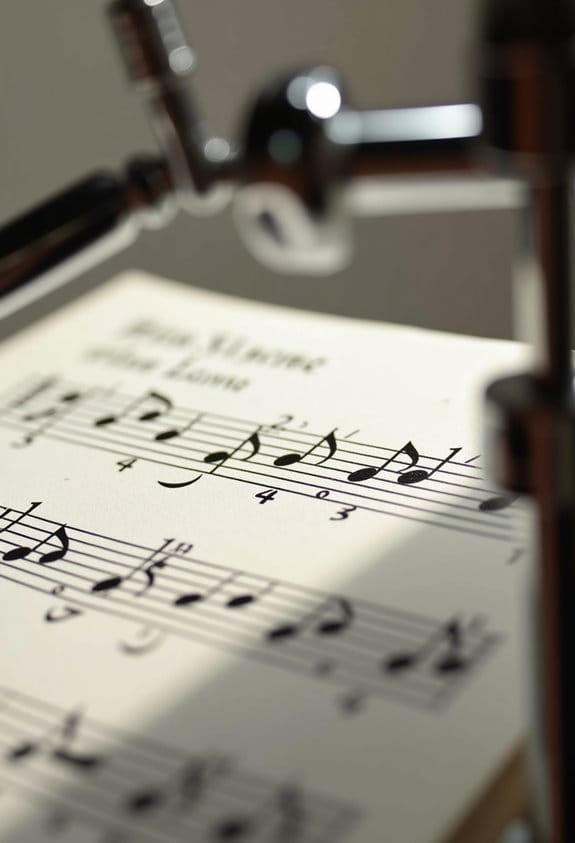
Understanding how to read time signatures is fundamental for anyone who plays the drums or engages with percussion. Time signatures, represented as two stacked numbers at the beginning of a piece, indicate how many beats are in each measure (the top number) and the type of note that receives one beat (the bottom number). For instance, in a common 4/4 time signature, there are four beats per measure, with each quarter note getting one beat. This system creates a rhythmic structure essential for coordinating with other musicians. By mastering various time signatures, drummers can adapt their playing to different styles and genres, greatly enhancing the feel and flow of the music, while ensuring each measure is filled appropriately with the correct counts. The 4/4 time signature is especially popular as the foundation for many rock and pop rhythms.
Recognizing Note Values
How can one effectively recognize note values in drum notation? Drum notation uses various note values to indicate how long each note should be played. The quarter note (♩) receives one beat, while the eighth note (♪) lasts for half a beat, and the sixteenth note (♫) occupies a quarter of a beat. Whole notes (𝅝) extend over four beats, thereby shaping the rhythm within a measure. In a typical 4/4 time signature, the sum of all notes fits within four beats. Recognizing these note values, including corresponding rests, is essential for understanding rhythm and timing. Additionally, notes played on the bass drum are distinguished by downward-facing stems, allowing for a clear separation between hand-played notes and those struck with the feet. Utilizing interactive audio and video demonstrations can greatly enhance the process of learning to read and internalize drum notation.
Identifying Rests and Their Importance
In drum notation, rests play a pivotal role in shaping the overall rhythm and dynamic of a musical piece. Rests represent moments of silence, allowing drummers to create structure and timing in their playing. Each rest type corresponds to specific note values; for instance, quarter rests signal silence for one beat, while eighth rests indicate silence for half a beat. Dotted rests enhance timing by extending their duration by 50 percent, making them significant in dynamic patterns. Identifying and interpreting these rests is vital for maintaining proper timing, ultimately enhancing performance. By incorporating rests, drummers can develop tension and release, adding depth to their interpretation and elevating the overall musical experience. Understanding rests is essential for every drummer’s toolkit. Practicing these fundamentals alongside drum rudiments helps to improve overall rhythmic proficiency and execution.
How to Read and Interpret Accents
Accents in drum notation serve as essential indicators that enhance the expressiveness of a performance, allowing drummers to emphasize specific notes. These accents, often represented by a small triangle or a heavy dot above a note, signal that the sound should be louder than non-accented notes, creating a dynamic variation. Drummers should pay attention to the intensity of these emphasized notes, which can range from moderately loud to fully pronounced. Incorporating accents into various drumming techniques, like highlighting the backbeat on a snare drum, is vital for creating rhythmic interest. Practicing accents alongside non-accented notes promotes consistent timing while varying volume, ultimately improving musicality and expression, enriching the overall sound and feel of the performance. Using a drum shield can help control the acoustic environment, allowing drummers to better hear the nuance of accented notes during practice and recording sessions.
Dynamics in Drum Notation
Dynamics in drum notation play a significant role in shaping the expressive quality of a performance, closely linking to the previously mentioned accents. Dynamic markings, such as ppp for triple pianississimo to fff for triple fortississimo, indicate varying levels of softness and loudness. Crescendo symbols signify a gradual increase in volume, while decrescendo symbols represent a gradual decrease. Additionally, “subito” indicates an abrupt dynamic change, and “fortepiano” (fp) denotes a loud note followed immediately by a soft one. Understanding these dynamics is essential for adding expression to drumming. Accents enhance specific notes through various symbols, while knowledge of dynamics allows drummers to employ diverse playing techniques, ultimately enriching the musical experience and highlighting emotional nuances during performances. The choice of drum set materials, such as poplar wood shells, can also influence the tonal response and dynamic range achievable by a drummer.
Directions and Repeats in Sheet Music
Understanding directions and repeats in drum notation is vital for interpreting sheet music effectively. Directions provide specific instructions for drummers, including dynamics and accents that enhance musical expression. Repeat signs, commonly depicted as two vertical lines with dots, indicate sections of the song meant to be played multiple times. First and second endings offer alternate endings for specific passages without requiring entire rewrites. Additionally, the symbols D.S. (Dal Segno) and D.C. (Dal Capo) instruct drummers to return to designated points in the score, promoting efficient navigation. Incorporating rehearsal letters aids drummers in locating and managing different sections, such as verses or choruses, seamlessly during performance. Mastery of these elements is vital for anyone enthusiastic to play drums proficiently. Using high-quality sheet protectors and covers can help preserve your drum notation from wear and damage during practice and transport, emphasizing the importance of durability and protection even for your sheet music.
Exploring Different Types of Drum Charts
Drum charts serve as essential tools for drummers, offering varied formats that cater to different playing styles and musical contexts. Among these, lead sheets provide key elements but require interpretation, allowing the drummer to creatively fill in patterns. Road maps function as guides, outlining song sections and indicating dynamics, which help the drummer navigate their performance. Drum tablature, a simplified notation form, uses horizontal lines for different drum parts, designating “x” for cymbals and “O” for accented notes. Mastering these diverse chart types—alongside traditional notation—enhances a drummer’s versatility and adaptability. By becoming skilled in reading and writing such charts, drummers gain the ability to interpret music effectively, ultimately promoting overall drumming proficiency and enriching their playing experience. Incorporating interactive features from modern drum lesson apps can further improve your reading and playing skills by providing real-time feedback and engaging practice opportunities.
Tips for Beginner Drummers
Beginning the journey of drumming can be both exciting and challenging for newcomers. To set a solid foundation, it’s essential for beginner drummers to familiarize themselves with the basic elements of drum notation, including how the drum staff reveals different components like the bass drum and snare. Counting aloud during practice solidifies understanding of note values, which are fundamental for accurate timing and coordination. Utilizing a metronome in practice sessions helps maintain a steady tempo, important for developing skills. Beginner drummers should start with simple rhythms, progressively tackling more complex patterns to avoid feeling overwhelmed. Breaking songs into smaller sections can also aid in mastering specific drum parts, thereby improving overall reading skills and performance. Additionally, exploring diverse drum patterns can inspire creativity and help beginners adapt to various musical styles.
Ready to Start Practicing?
For those enthusiastic to begin their drumming practice, establishing a structured routine is key to mastering the skills needed to read drum notation effectively. First, beginners should familiarize themselves with the drum staff, where the lines and spaces correspond to various components of the drum kit, including the bass drum and snare. Practicing counting beats aloud with a metronome helps internalize rhythm while reading drum notation. Start with simple quarter notes and gradually move to complex rhythms, ensuring accuracy in note values. Employing notation software can enhance understanding by visualizing and manipulating patterns. Additionally, regularly reviewing dynamics and rests is essential for playing and interpreting notation, making reading drum an enjoyable and beneficial experience.
Frequently Asked Questions
What Materials Do I Need to Start Reading Drum Notation?
To start reading drum notation, one needs drum sticks, a practice pad, a metronome, and sheet music. Utilizing online resources, video tutorials, drumming books, and rhythm exercises helps understand notation symbols and various learning methods.
How Long Will It Take to Learn Drum Notation?
Learning drum notation varies greatly, influenced by learning pace, practice frequency, individual differences, instruction methods, genre preferences, resource availability, motivation levels, past experience, cognitive skills, and time commitment, making a definitive timeframe difficult to ascertain.
Can I Use Drum Notation for Other Percussion Instruments?
Yes, drum notation is adaptable for various percussion instruments. It facilitates rhythmic training, accommodates different rhythm patterns, and supports instrument versatility. Educational resources often provide notation adaptations suitable for percussion ensembles and genre variations, enhancing overall musicianship.
Are There Apps That Help With Reading Drum Notation?
Numerous drum apps exist that facilitate notation practice, incorporating rhythm games and sight reading features. Interactive learning through percussion software and drum lesson platforms includes metronome tools, notation tutorials, and access to digital sheet music for thorough understanding.
How Can I Improve My Sight-Reading Skills for Drumming?
To improve sight-reading skills, one should incorporate sight reading exercises, rhythmic dictation, and metronome drills into practice routines, while seeking teacher feedback, engaging in group practice, transcribing songs, and exploring various musical genres for enhanced reading fluency.


