As an Amazon Associate, we earn from qualifying purchases. Some links on this site are affiliate links at no extra cost to you. Our recommendations are based on thorough research and editorial judgment.


The Mathematics Behind Drum Subdivision

The mathematics behind drum subdivision involves essential concepts like binary pulse and time signatures, which lay the groundwork for rhythmic patterns. Basic rhythms utilize “on” and “off” elements, forming various note types. Advanced structures, such as triplets and polyrhythms, add depth and complexity, creating unique textures in music. Time signatures illustrate beat relationships, while mathematical sequences like Fibonacci enhance composition flow. Ultimately, these elements unify the art of drumming, inviting musicians to explore rhythmic possibilities further.
Key Takeaways
- Drum subdivision relies on binary pulse, distinguishing between “on” (hit) and “off” (silence) elements for rhythmic structure.
- Time signatures, like 4/4, dictate how beats are organized and subdivided within measures.
- Triplets divide beats into three equal parts, enhancing rhythmic complexity and fluidity in various styles.
- Polyrhythms involve layering different rhythms, allowing for unique textures and creative rhythmic exploration.
- Subdivisions of beats represent fractions that blend timing, dynamics, and ratios in rhythmic equations.
Binary Pulse: The First Mathematical Code

You may be interested

How Drummers Read Lead Sheets and Charts
January 11, 2026

How to Analyze Song Structure as a Drummer
January 11, 2026

How to Count Odd Time Signatures Like 5/4 and 7/8
January 11, 2026
In the world of music, the binary pulse emerges as a foundational mathematical code that underpins rhythmic structures, illustrating how simple elements can create intricate compositions. This pulse consists of “on” (hit) and “off” (silence) elements, forming the basis for various notes. For instance, in one measure, quarter notes represent one beat each, while eighth notes divide that beat into two segments. Furthermore, the sixteenth note further subdivides it, allowing for complex rhythms played with one hand. These different subdivisions provide a framework that enhances the rhythmic structure in music. Binary drumming patterns, such as Boom–chick and Djembe slap–tone, highlight the depth achievable within this seemingly simple binary system, showcasing its versatility across genres. Mastering the shuffle groove’s triplet feel further refines the player’s ability to navigate complex rhythmic subdivisions with precision and expressiveness.
Triplets and Ternary Time: The Magic of Three

Rhythmic divisions in music often reveal fascinating patterns, and triplets stand out as a prime example of this complexity. By dividing a beat into three equal parts, triplets create a unique rhythmic texture that contrasts sharply with binary rhythms. The allure of ternary time is evident in diverse musical styles, including jazz swing, West African kassa, and Latin 6/8, where the division of beats introduces a fluid, circular quality. Additionally, the 3:2 hemiola pattern—three beats interlocking with two—adds further dynamism, often found in clave rhythms superimposed over conga grooves. When combined with binary rhythms, triplets enrich the overall complexity, expanding the expressive possibilities in music-making and inviting listeners to experience rhythmic magic in unexpected ways. To practice mastering these intricate rhythms, many drummers turn to play-along tracks that offer customizable tempo and looping options for targeted skill development.
Time Signatures: Fractions as Musical Architecture
Musical architecture is intricately built upon time signatures, which function like fractions that illustrate the relationship between beats and note values. For example, a 4/4 signature stipulates four quarter notes per measure, creating a steady rhythmic foundation. Common time signatures like 6/8 introduce a sense of swing, while 5/4 can evoke a feeling of unpredictability, enhancing emotional textures in music. Odd time signatures, such as 7/8 or 11/16, present more complex ratios that challenge traditional counting methods and allow for innovative subdivisions, enriching temporal dynamics. This mathematical framework not only aids composers in structuring their music but also plays an important role for drummers, ensuring precise timing and cohesive rhythmic performances essential for any ensemble. Understanding these signatures also provides drummers with unique opportunities to develop odd time signature mastery and expand their rhythmic creativity.
Recommended Products

Aklot Metronome Ⅱ expands on the standard metronome by adding a 24-hour time mode and beat loop function—packing 4 features into 3 intuitive modes. Plus, you can adjust screen brightness and vibration intensity via the companion app, delivering comfortable yet precise beat vibrations for the wearer.

Aklot Metronome Ⅱ expands on the standard metronome by adding a 24-hour time mode and beat loop function—packing 4 features into 3 intuitive modes. Plus, you can adjust screen brightness and vibration intensity via the companion app, delivering comfortable yet precise beat vibrations for the wearer.
Polyrhythms and Cross-Rhythms: The Geometry of Overlay
While engaging with the complexities of rhythm, one can easily encounter the fascinating world of polyrhythms and cross-rhythms, which serve as powerful tools for creating intricate musical arrangements. Polyrhythms are formed by layering two or more distinct rhythms simultaneously, such as the popular 3:4 ratio, where a three-beat cycle syncopates with a four-beat cycle. This leads to unique rhythmic textures, enhanced by visual tools like circle diagrams that elucidate the rhythmic synchronization of these overlapping cycles. Cross-rhythms further develop this concept by introducing varying groupings, generating tension and release within compositions. The study of these rhythmic structures echoes principles from sacred geometry, illustrating harmony and the mathematical relationships embedded in the art of music. Musicians often enhance these rhythmic explorations using triple flange drum hoops to achieve greater tonal clarity and resonance.
Recommended Products

MADE TO FIT 12-INCH TOMS WITH 6-LUG CONFIGURATION: The Gibraltar SC-1206TT is precision-engineered to fit 12-inch tom drums with a 6-lug setup, providing a snug and secure fit that makes it easy to upgrade or replace your drum’s original hoop.

FITS 13 INCH DRUMS WITH 8 LUGS FOR UNIVERSAL COMPATIBILITY: Designed to match most 13" snare and tom drums with 8-lug configurations, this batter hoop offers an easy, direct replacement for damaged, warped, or worn rims.

PRECISION FIT FOR 14-INCH SNARE DRUMS WITH 10 LUGS: This snare-side drum hoop is engineered to fit the bottom of standard 14-inch snare drums with a 10-lug configuration, making it a highly compatible upgrade for a wide range of acoustic snare drums from major drum brands.
The Fibonacci Sequence and Rhythmic Growth
Applications of the Fibonacci sequence extend far beyond mere numbers, infiltrating the domains of music and rhythm with striking elegance. In rhythmic exploration, composers often create intricate patterns using Fibonacci numbers, crafting sequences of beats that sum to 16 by combining 3, 5, and 8 beats effectively. This method enhances the natural flow within compositions, as rhythmic crescendos and shifts can mimic growth patterns found in nature. By applying Fibonacci principles, musicians introduce nuanced variations, maintaining listener interest and effectively avoiding repetitive structures. This mathematical framework resonates with musical structure, connecting artistic expression to the underlying patterns that govern both music and nature, demonstrating the profound relationship between numbers and rhythmic creation. Incorporating diverse music styles when using Fibonacci-based patterns can further enrich the rhythmic texture and appeal to a wide range of musical tastes.
Recommended Products
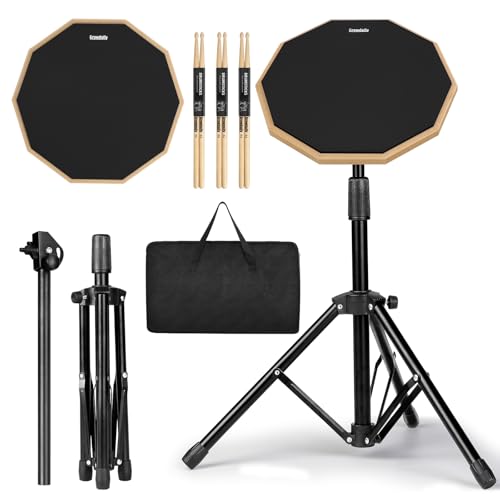
Drum Pad:GrowDaily drum practice pads are the perfect practice pad for any drummer, providing a realistic playing experience with a high resilience rubber and solid poplar base, and high-density shock absorbing cotton for a near snare drum feel.

🎸【TPR ENVIRONMENTAL DRUM HEAD MATERIALS】: 10" Novel design drum pad; More interesting practice pad with the pad with audible metronome beating sound;

The Golden Ratio (Phi) in Musical Timing
How does the concept of the Golden Ratio, often found in nature and art, shape the world of music? Known as Phi, this ratio, approximately 1.618, plays a crucial role in musical timing. In drum composition, applying the Golden Ratio leads to the creation of rhythmic patterns that alternate between shorter and longer phrases, fostering a sense of balance and Rhythmic Serenity. Composers often incorporate Fibonacci numbers, linked to this ratio, to define the number of beats or subdivisions within a rhythmic cycle, which results in organic growth in musical themes. The integration of the Golden Ratio introduces unique rhythmic asymmetries, evoking emotional responses from listeners, while also illustrating how mathematics profoundly influences the aesthetics of music and its timing. Ensuring stability and durability in drum mounting systems is essential to maintaining the integrity of these complex rhythmic patterns during performance.
Recommended Products

PRACTICE ANYTIME, ANYWHERE - GLEAM Drum Practice Pad provides the best practice substitute to acoustic drums, so you can practice rudiments, paradiddles or just drum along to that song on the radio – without disturbing anyone. Portable and quiet, it works on any surface including carpet, table, lap or inside a standard snare basket.

Drum Pad: GrowDaily drum practice pads are the perfect practice pad for any drummer, providing a realistic playing experience with a high resilience rubber and solid poplar base and high-density shock-absorbing cotton for a near snare drum feel

Drum Pad:GrowDaily drum practice pads are the perfect practice pad for any drummer, providing a realistic playing experience with a high resilience rubber and solid poplar base, and high-density shock absorbing cotton for a near snare drum feel.
Fractals, Recursion, and Self-Similar Rhythms
Fractals, which are intricate patterns that repeat at various scales, serve as a fascinating concept in music, particularly within the domains of rhythm and melody. In rhythmic structures, recursion plays a key role, as musicians often return to a simple motif, layering it to generate increased complexity. This method creates depth, allowing the initial idea to evolve while retaining its essence. Similarly, self-similar rhythms appear across genres, where a straightforward pattern is transformed, yet its core remains intact. These dynamic manifestations of Fractal Dynamics illustrate how complex patterns emerge from simple elements. By reflecting natural patterns, these mathematical relationships amplify the emotional resonance of music, drawing audiences deeper into rhythmic experiences that feel both familiar and profound. Moreover, practicing these rhythms on specialized tools like double-sided practice pads can enhance a musician’s ability to internalize and reproduce such complex patterns.
The Drum Is a Living Equation
Rhythmic patterns on a drum serve as a living equation, where each strike generates a mathematical event that resonates far beyond mere sound. Each hit acts as part of a rhythmic equation, blending concepts of timing, dynamics, and ratio in a complex dance reminiscent of rhythmic symmetry. This interplay between hits creates subdivisions of beats, representing fractions that define the overall rhythm. When drummers incorporate Fibonacci sequences, they produce organic growth in their patterns, reflecting natural forms seen in biology. Consequently, drumming transforms into more than counting; it synthesizes logic, mathematics, and spiritual expression, establishing a connection between the musician and the broader rhythmic universe. This living equation showcases the beauty of both art and science in music. Furthermore, organizing cymbals on a sturdy cymbal display rack not only protects the instruments but also enhances the visual rhythm of the musical setup.
Frequently Asked Questions
What Is the 80/20 Rule in Drumming?
The 80/20 rule in drumming states that 80% of results stem from 20% of practice, emphasizing the importance of mastering foundational dynamic patterns and rhythms to enhance overall performance and versatility effectively.
What Is the Math in Drumming?
The math in drumming intricately weaves through rhythm patterns, employing time signatures, subdivisions, and tuplets. Such calculations enhance musical depth, enabling drummers to explore complex textures and create fascinating polyrhythmic experiences that resonate deeply.
Why Was the Talking Drum Banned?
The talking drum was banned primarily due to cultural sensitivity concerns. Colonial authorities feared its capacity to communicate resistance, coordinate uprisings, and undermine their control, prompting efforts to suppress this essential symbol of cultural expression and identity.
What Are Subdivisions in Drumming?
In a lively jam session, a drummer employs subdivision techniques, breaking the beat into smaller units like sixteenth notes. Subdivisions enhance rhythmic complexity, allowing for intricate patterns that elevate the overall texture of the music.


